Turn a client question into a LinkedIn post, without inventing a client story
A practical workflow for consultants: separate a useful question from private context, write a specific answer and review an AI-assisted draft before publishing.
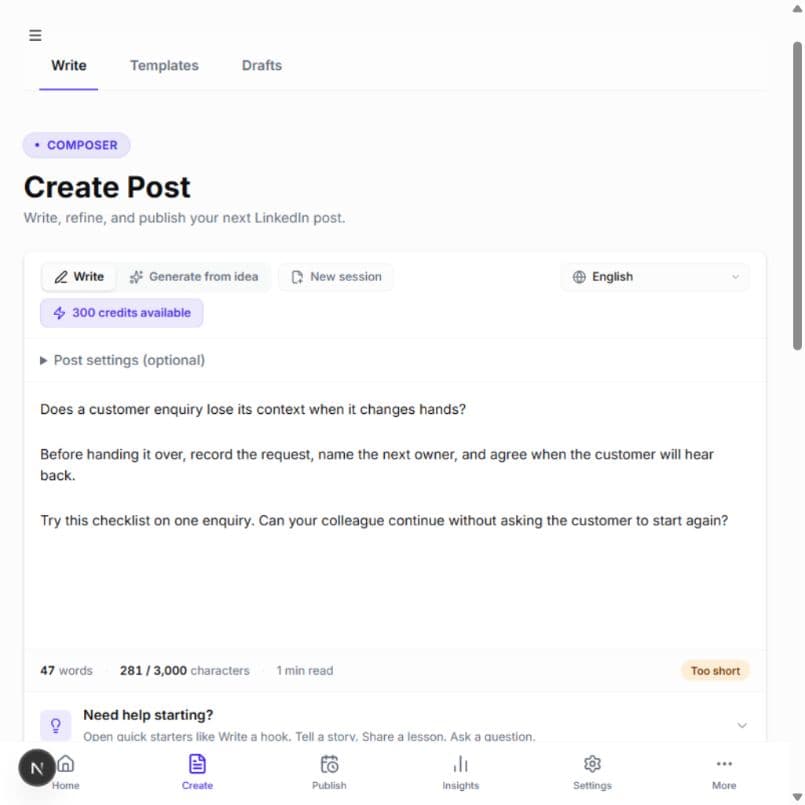
Publish the answer, not the private conversation
Yes, a client question can become a useful LinkedIn post without becoming a case study. Rewrite the question in general terms, remove identifying details, and explain your reasoning with a clearly labelled hypothetical example. Do not add a client quotation, result or personal anecdote that you cannot support.
For a consultant or agency owner, this creates a practical way to show how you think between larger projects. HumanEcho’s repurposing tool can turn your cleaned notes into post options. Your job is to supply the substance and check that the draft has not turned advice into a claim about work you performed.
Choose a question that contains a real decision
Start with something you can answer precisely: “Who should approve a design when several people have feedback?” is more useful than “Why does good communication matter?” The first question lets you give the reader a next step, a boundary and an example.
Do not call a question “frequently asked” unless it genuinely is. One relevant question is enough. If the question is hypothetical, introduce it as a scenario rather than claiming a client asked it yesterday.
Keep the decision; drop the invented story
- Unsupported case-study framing
- Last week, we rescued a client’s delayed launch by fixing their approval process. Here is what transformed the project.
- Useful question-led framing
- Who approves a design when three people have feedback? Separate the people giving input from the person who can accept the final version. Agree on that responsibility before the next review.
Illustrative wording, not a report of a client engagement.
Create a clean source note before using AI
- Question: What decision is the reader trying to make?
- Answer: What would you recommend, and why?
- Boundary: When would that advice need to change?
- Example: What invented scenario illustrates the decision without implying a real result?
- Next step: What can the reader check or do after reading?
Write this note in your own words instead of pasting a private email, meeting transcript or screenshot. Removing a name is not enough if the combination of sector, timing and project details still identifies the client. If the point depends on confidential facts, choose another question.
Give the writing tool a brief, not permission to embellish
Open HumanEcho’s repurposing tool and paste the cleaned note into Source content. Choose the source type that fits, specify the audience, and select the tone, language and post style. For an answer like this, an educational tone and a lesson or tactical format are a better starting point than a story format.
Include a direct instruction in the source: “Write general advice. Do not invent a client, quotation, statistic or result. Keep the example hypothetical.” This instruction helps define the task; it does not replace checking the output.
Read a complete brief and illustrative post
Prepared editorial example. This is not a generated result, testimonial or account of a real project.
- Source note
- Audience: agency owners managing design reviews. Question: who approves a design when several people give feedback? Answer: identify who consolidates feedback and who confirms final acceptance; they may be the same person; keep required specialist reviews. Boundary: formal approval requirements still apply. Example: a hypothetical website page reviewed by sales, design and the founder. Next step: agree who resolves conflicting comments before the next review. Write general advice; do not invent a client story or result.
- Illustrative post
- Who approves a design when three people have feedback? Before the next review, agree on two things: who gathers the comments, and who can accept the final version. Imagine a website page reviewed by sales, design and the founder. If one person asks for a longer explanation and another asks for less text, the designer needs a decision, not three competing instructions. Name the person who resolves that conflict and returns one agreed set of comments. Keep any required specialist reviews in the process. Before your next design review, check: does everyone know who makes the final call?
Review the verbs before you publish
Look for words that quietly change the evidence: “we delivered,” “our client achieved,” “we discovered” or “this saved.” If the source only contains advice, those verbs may introduce a false claim. Replace them with a recommendation or a clearly hypothetical example.
Then check the answer itself. Does the opening answer the question? Is the limitation still present? Could someone act on the final sentence? Remove a generic paragraph if it adds nothing to those three checks.
Saving to the HumanEcho workspace requires sign-in. Review the draft before any publishing step; saving is not publishing. This workflow does not promise leads or permission to share a private conversation.
